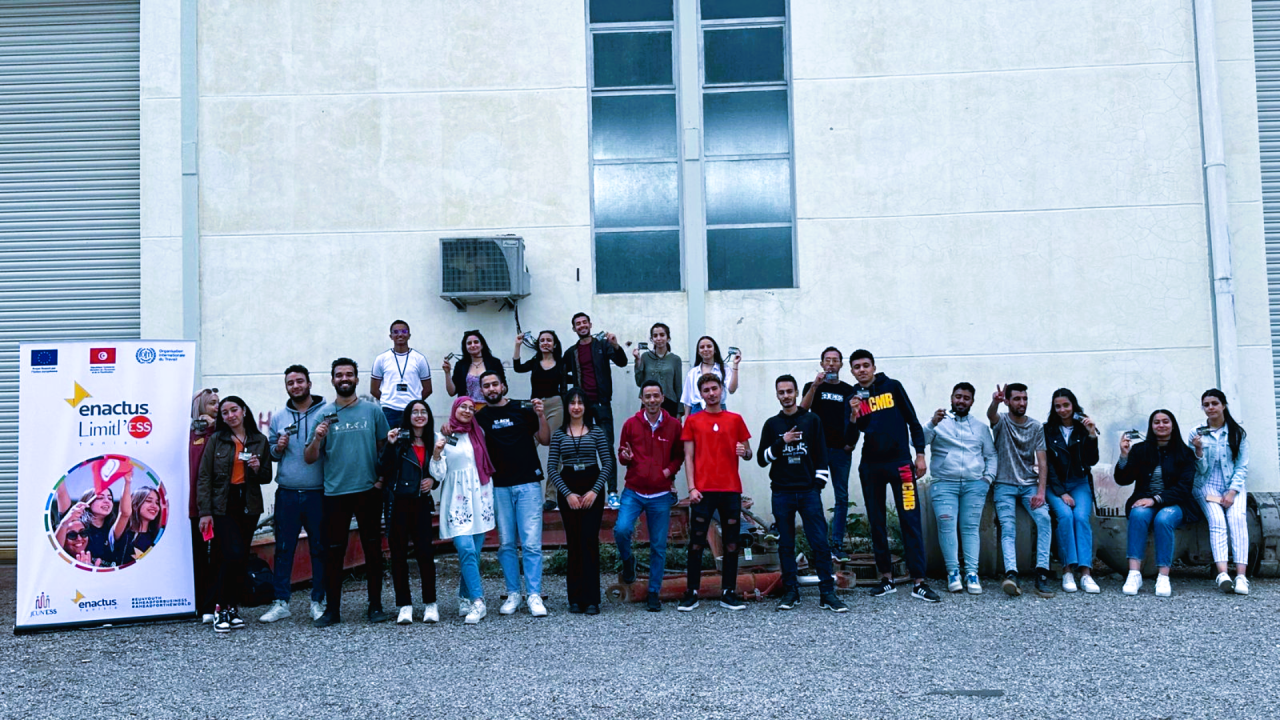
Back in 2023, as Program Manager with Enactus Tunisia in the Northwest, I spent much of my time on the road. Traveling between Kasserine, Kef, Siliana, Béja, and Jendouba was not just part of my role; it was where the program truly came to life. Each visit revealed a region too often reduced to statistics, yet rich in resilience, creativity, and untapped potential. Behind every challenge was a young person questioning assumptions, testing ideas, and quietly building solutions rooted in lived experience.
What began as routine field visits to audit and support student-led projects soon became a deeper reflection on what inclusive access to economic opportunity really means for youth in underserved regions. Across the Northwest, I encountered young women and men who were not waiting for change to come from the center. Instead, they were designing it themselves, using entrepreneurship not as an abstract concept, but as a practical response to unemployment, environmental degradation, and social exclusion.
Our journey in Kasserine immediately underscored the role of rural women as key economic actors. In agricultural fields across the region, young women were already sustaining local economies, yet often without job security, social protection, or recognition. Enactus Limitl’ESS ISET Kasserine addressed this gap by creating pathways to decent work through access to safe transportation, insurance coverage, and structured employment. By leveraging an accessible digital platform, the team demonstrated how targeted innovation can dismantle systemic barriers and amplify women’s economic participation.
Still in Kasserine, Enactus Limitl’ESS ISAM Kasserine reimagined waste as opportunity by transforming repurposed coffee grounds into sustainable, natural cosmetic products. Their project blended environmental responsibility with market viability, illustrating that sustainability and entrepreneurship are not competing goals, but complementary ones.
In Kef, the diversity of youth-led innovation was particularly striking. Enactus Limitl’ESS ESA Kef focused on empowering small farmers, especially women, through sustainable agriculture. By developing an affordable natural fertilizer derived from locally sourced nettles, they reduced dependence on chemical inputs while promoting biodiversity and soil health. Their approach reflected a deep connection to the land and a clear understanding of local constraints.
Enactus Limitl’ESS ISET Kef addressed another pressing challenge through environmentally friendly pest control solutions. By exploring alternatives such as sound waves and natural repellents, the team sought to protect homes, crops, and ecosystems without relying on harmful chemicals. Their work showed how innovation inspired by nature can offer safer and more sustainable responses to everyday problems.
At Enactus Limitl’ESS ISEAH Kef, students worked to preserve ancestral knowledge while creating economic value through the production of sustainably sourced essential oils. By partnering with forest-dependent communities and adhering to fair trade principles, they demonstrated how ethical supply chains can strengthen livelihoods while protecting fragile ecosystems.
Environmental commitment also defined the work of Enactus Limitl’ESS ISI Kef, whose project tackled plastic pollution through edible water capsules. Designed as biodegradable alternatives to plastic bottles at events, the initiative combined public health awareness with responsible consumption, proving that bold ideas do not have to be complex to create meaningful impact.
In Siliana, Enactus Limitl’ESS ISAM Siliana brought circular economy principles into everyday life by producing eco-friendly, affordable furniture made from recycled paper and sustainable materials. Their work illustrated how waste reduction can translate into practical, accessible solutions for students with limited budgets.
Béja offered powerful examples of inclusivity-driven innovation. Enactus Limitl’ESS ISET Béja focused on improving the quality of life for visually impaired individuals through affordable assistive technologies that promoted independence and dignity. Their solutions reinforced the idea that disability should never be a barrier to participation.
In parallel, Enactus Limitl’ESS ISLAI Béja developed an inclusive value chain around snail farming, involving forest-dependent communities, particularly women and small farmers, in the production of cosmetic products. By combining ethical farming, income generation, and environmental stewardship, the initiative demonstrated how equitable value chains can drive shared prosperity.
Enactus Limitl’ESS Biotech Béja introduced a technological dimension by supporting small farmers with bio-fertilizers and a decision-support application. Their work bridged traditional agricultural practices with digital innovation, enabling farmers to improve yields while adopting more sustainable methods.
Our final stop in Jendouba revealed initiatives equally rooted in sustainability and community impact. Enactus Limitl’ESS ISP Tabarka introduced off-ground cultivation tools designed to conserve water, protect soil health, and strengthen local food systems. Meanwhile, Enactus Limitl’ESS FSJEG Jendouba promoted sustainable tourism by connecting travelers to authentic local experiences, supporting local producers, and encouraging responsible travel choices.
Enactus Limitl’ESS ISSH Jendouba focused on building a sustainable supply chain for high-quality essential oils by working directly with local growers under fair trade principles. Their approach showed how quality, ethics, and impact can coexist within competitive markets.
Across this journey, one lesson became unmistakably clear: youth in underserved regions do not lack ideas, ambition, or capability. What they often lack is inclusive and decentralized access to opportunity. The Enactus Tunisia Limitl’ESS program demonstrated that when young people are trusted, equipped, and supported by a responsive ecosystem, they can transform lived challenges into scalable solutions.
As Program Manager for Enactus Tunisia in the Northwest, I was humbled and inspired by the commitment of these young change-makers. Their projects were not isolated experiments, but signals of what is possible when entrepreneurship is rooted in community realities and guided by purpose.
To the Enactus Tunisia Limitl’ESS students, your journey is only beginning. Embrace uncertainty, learn from setbacks, and remain grounded in the communities you serve. Your creativity and determination are already shaping a more inclusive and sustainable Tunisia.
To the communities and partners who welcomed us, thank you for your trust and collaboration. Together, we are rewriting the narrative of marginalized regions, transforming them into hubs of innovation, dignity, and opportunity.
As we reflect on Kasserine, Kef, Siliana, Béja, and Jendouba, one truth endures: inclusive access to economic opportunity for youth is not optional. It is the foundation upon which resilient communities, sustainable innovation, and futures without boundaries are built.